Soviet Montage Explained: Kuleshov, Eisenstein, Pudovkin and the Cut That Thinks
A century ago a handful of Soviet filmmakers decided that meaning in cinema lives between shots, not inside them. Here is what Kuleshov, Pudovkin and Eisenstein actually argued, how the Odessa Steps sequence works shot by shot, and why every editor still uses their ideas.
Every editing tutorial eventually says the same sentence: a cut creates meaning that neither shot had on its own. The sentence is a hundred years old. It was worked out, argued over and put on screen in Moscow in the 1920s by a group of filmmakers who had very little film stock, a state that wanted propaganda, and a conviction that cinema was a language whose grammar nobody had yet written down.
The names are Lev Kuleshov, Vsevolod Pudovkin, Sergei Eisenstein and Dziga Vertov. Their ideas are usually compressed into one slogan ("montage") and one sequence (the Odessa Steps). This piece unpacks both, and then looks at what an editor working today has actually inherited from them.
Kuleshov: the face that meant three things
Lev Kuleshov ran a workshop at the Moscow film school in the early 1920s, and the experiment attached to his name is the founding anecdote of editing theory. As Pudovkin later described it, Kuleshov took a close-up of the actor Ivan Mozzhukhin with a neutral expression and cut it three times against three different shots: a bowl of soup, a child's coffin, a woman on a divan. Audiences, the story goes, praised the actor's subtle hunger, his restrained grief, his desire. It was the same shot each time.
Whether the experiment happened exactly as told has been debated for decades; the footage does not survive. It does not matter much. The principle has been demonstrated so many times since, most famously by Alfred Hitchcock in a 1960s television interview, smiling at a woman with a baby and then, with the identical smile, at a young woman in a bikini, that the "Kuleshov effect" is simply a fact about how audiences watch. We read the face by what it is cut against. The shot has no fixed meaning until the edit assigns one.
Kuleshov drew a second conclusion that is just as useful. He assembled a "creative geography": a man walking in one Moscow street, a woman in another, a handshake shot in a third location, a staircase from a fourth, and a final shot of the Capitol in Washington. Viewers saw one continuous meeting in one place. Space in cinema, he concluded, is built by the cut, not recorded by the camera. Every film that shoots the interior of a house in a studio and its exterior on a different continent is relying on this.
Pudovkin: linkage
Pudovkin, Kuleshov's student, turned these observations into a working method he called linkage. Shots are bricks; the film is built by laying them so that each leads to the next, and the audience assembles the meaning without noticing the joins. His own Mother (1926) is the textbook: the breaking ice on the river in spring is cut against a workers' march so that the two become one rising force, and the film ends on the image without ever having to say what it means.
Pudovkin's linkage is essentially the theory behind classical continuity editing everywhere. Shots should be selected for the one detail that advances the idea, and joined so smoothly that the viewer feels the idea rather than the cut. If you have ever been told to "cut on the action" or "show the detail, not the whole room," you have been taught Pudovkin.
Eisenstein: collision
Eisenstein disagreed, loudly and in print. Shots, he argued, should not link; they should collide. Meaning arises from conflict between two images, the way a spark arises between two electrodes. His 1929 essay on the methods of montage laid out a ladder of five kinds of conflict, and it is still the most useful vocabulary for describing what an edit is doing.
- Metric montage cuts by length alone. Shots get shorter according to a fixed pattern, regardless of content, and the audience feels the acceleration in the body before understanding it.
- Rhythmic montage lets the movement inside the frame determine the cut. A shot of soldiers marching downhill, held for exactly as long as the march needs, then a shorter shot of a running crowd. The rhythm of the content and the rhythm of the cutting reinforce or fight each other.
- Tonal montage cuts on emotional or visual tone: the dominant quality of light, the mood of a face, the softness of fog. The mourning sequence in Potemkin, with its mist and slow water, is his own example.
- Overtonal montage combines the previous three so that the total effect is more than any single dimension.
- Intellectual montage cuts between images that have no story connection in order to produce a concept. In Strike (1925) the massacre of workers is intercut with the slaughter of a bull. The film is not saying the workers are cattle; it is making the viewer think "slaughter" as an abstraction and apply it.
Eisenstein's ambition for the fifth method was enormous: he hoped to film Marx's Capital. He never did, and intellectual montage has remained the rarest kind. But the first four are in every action sequence and every music video cut today, usually without anyone knowing they are quoting a Soviet theorist.
The Odessa Steps, shot by shot
Battleship Potemkin (1925) dramatizes a 1905 mutiny, and its fourth act, the massacre on the steps of Odessa, is the sequence everyone means when they say "montage." It is worth watching with a notepad, because the principles above are all visible in it.
Time is stretched. The steps can be walked in a couple of minutes; the sequence runs far longer. Eisenstein achieves this not with slow motion but by overlapping action: the crowd starts to run, we cut to another angle in which they start to run again, and the moment is relived rather than continued. Real time is replaced by emotional time.
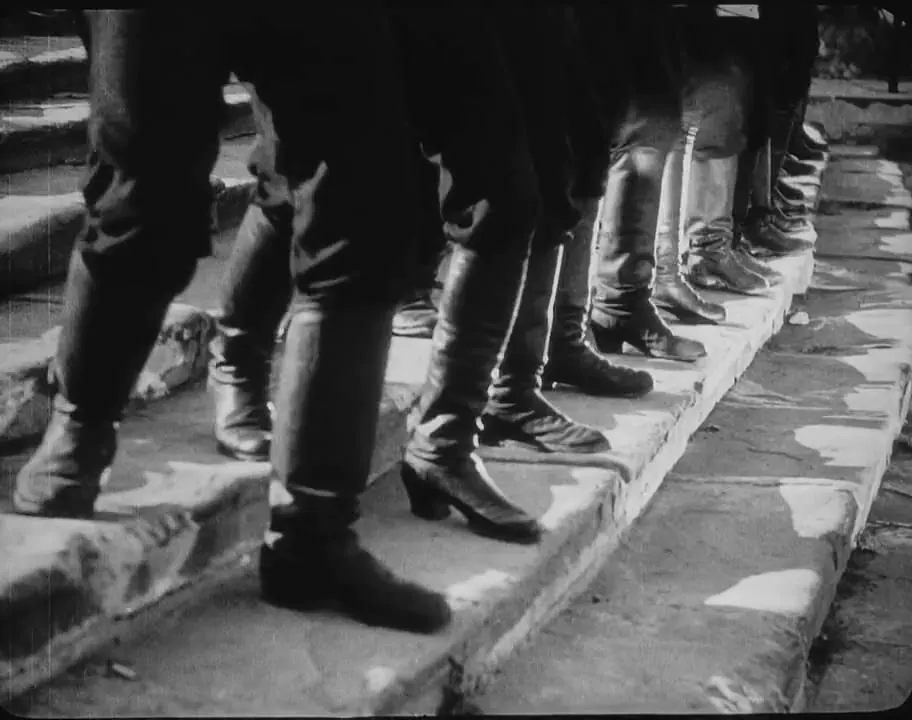
Direction is the argument. The soldiers move down the steps in a rigid diagonal line, always in the same direction, always as a mass of boots and rifles with no faces. The crowd moves down too, but chaotically, in every direction at once, and always as individuals: a mother, a student, a woman with pince-nez. The conflict of graphic directions and of mass against individual is the political content, delivered as geometry.
The cutting accelerates, then stops. Shot lengths shrink as the massacre intensifies (metric and rhythmic montage doing their work). Then, when the mother carrying her dead child walks up the steps toward the soldiers, the cutting nearly halts. The silence of a long take after a storm of short ones is unbearable, and it is entirely a matter of duration.
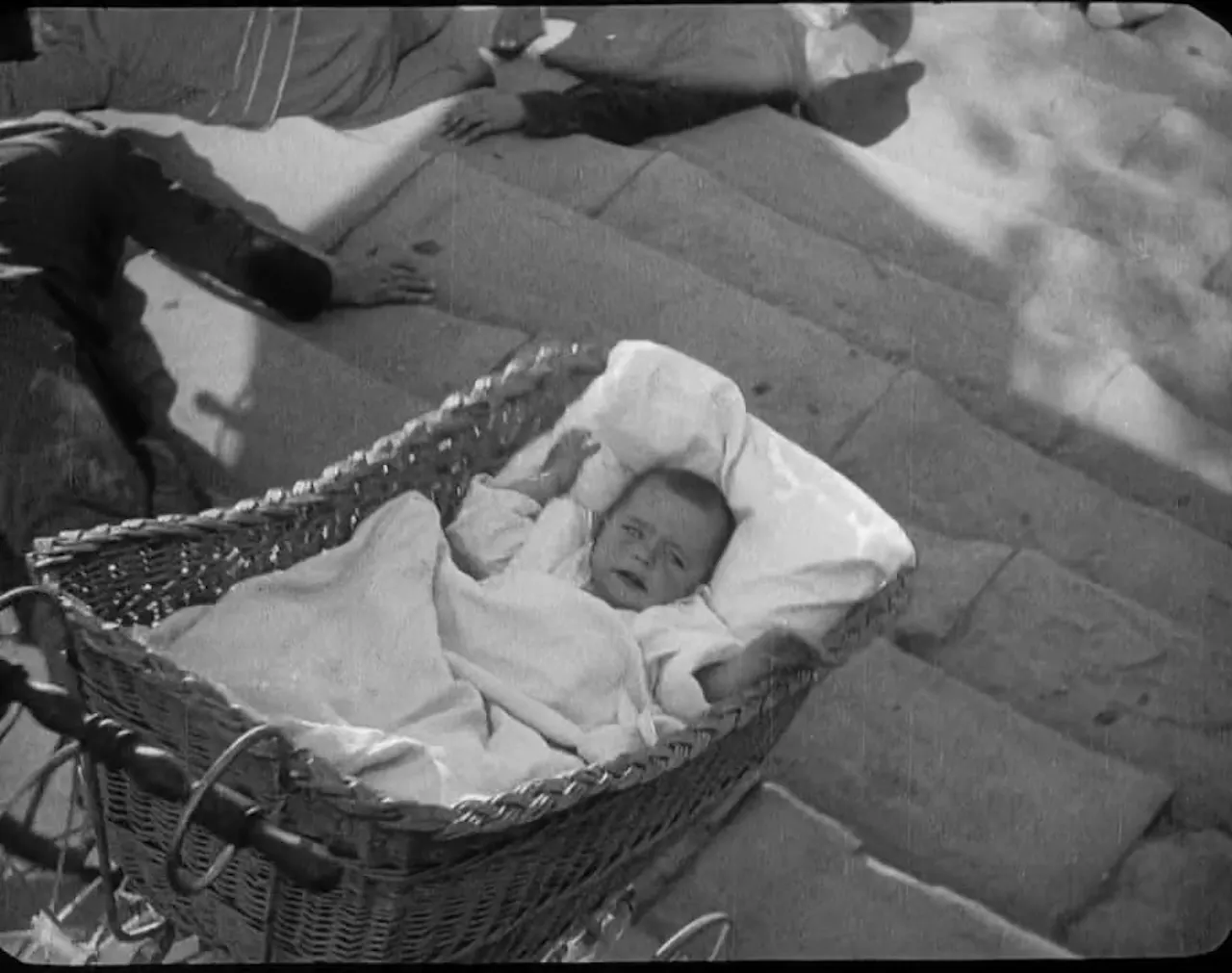
The baby carriage. The most quoted passage in film history is a small lesson in suspense by intercutting. A mother is shot; she falls against the carriage; the carriage begins to roll down the steps. Eisenstein cuts between the carriage, the horrified faces watching it, the soldiers' advance and the wheels, drawing out a few seconds of rolling into a long agony. We never see the carriage reach the bottom; we see a face, and the cut tells us the rest. Brian De Palma restaged the whole idea in a train station in The Untouchables (1987), which is the clearest proof that the mechanism does not depend on its original politics.
The lions. The act ends with three stone lions, one sleeping, one waking, one rising, cut in quick succession so that the statue appears to stand up. It is intellectual montage in miniature: three static objects become one idea, awakening, and the audience supplies the verb.
Vertov, in one paragraph
Dziga Vertov rejected staged fiction entirely and built Man with a Movie Camera (1929) out of documentary fragments of city life, cut to rhythms and rhymes rather than story. His "kino-eye" idea, that the camera sees better than the human eye and montage organizes what it sees, is the ancestor of every city symphony, essay film and, frankly, every well-cut montage sequence in a modern drama in which a life passes in ninety seconds of matched movements.
What an editor inherits
Strip away the politics and the manifesto tone, and the Soviets left a set of tools that are still the working vocabulary of the cutting room.
- The reaction shot is the story. Kuleshov's face tells you that what an audience feels about a shot comes from the shot next to it. Cut to the listener, not the speaker, when the line matters.
- Geography is built, not found. Creative geography is why you can shoot a chase across three cities and one parking garage.
- Duration is an instrument. Metric and rhythmic montage are the reason a fight scene accelerates and a death scene holds. Plan the pattern of shot lengths before you plan the shots.
- Graphic conflict reads instantly. A mass moving one way against individuals moving every way is understood before it is thought. Storyboard directions, not just content.
- Two unrelated images make a third idea. Used rarely and precisely, intellectual montage is still the most powerful cut there is. Used constantly, it is a music video.
The Soviets believed they were inventing a universal language. They were partly wrong; audiences have to learn to read cuts, and different cultures and periods read them differently. But they were right that the cut is where cinema thinks. A hundred years later, nobody has found a better place to look.