Kurosawa's Rashomon: Light Through Leaves, Rain, and a Camera That Will Not Sit Still
Rashomon is remembered for its idea, four accounts of one crime that cannot all be true. It deserves to be remembered for its images: Kazuo Miyagawa's sun through the forest canopy, ink-black rain at the gate, and a camera that moves as restlessly as the witnesses' stories.
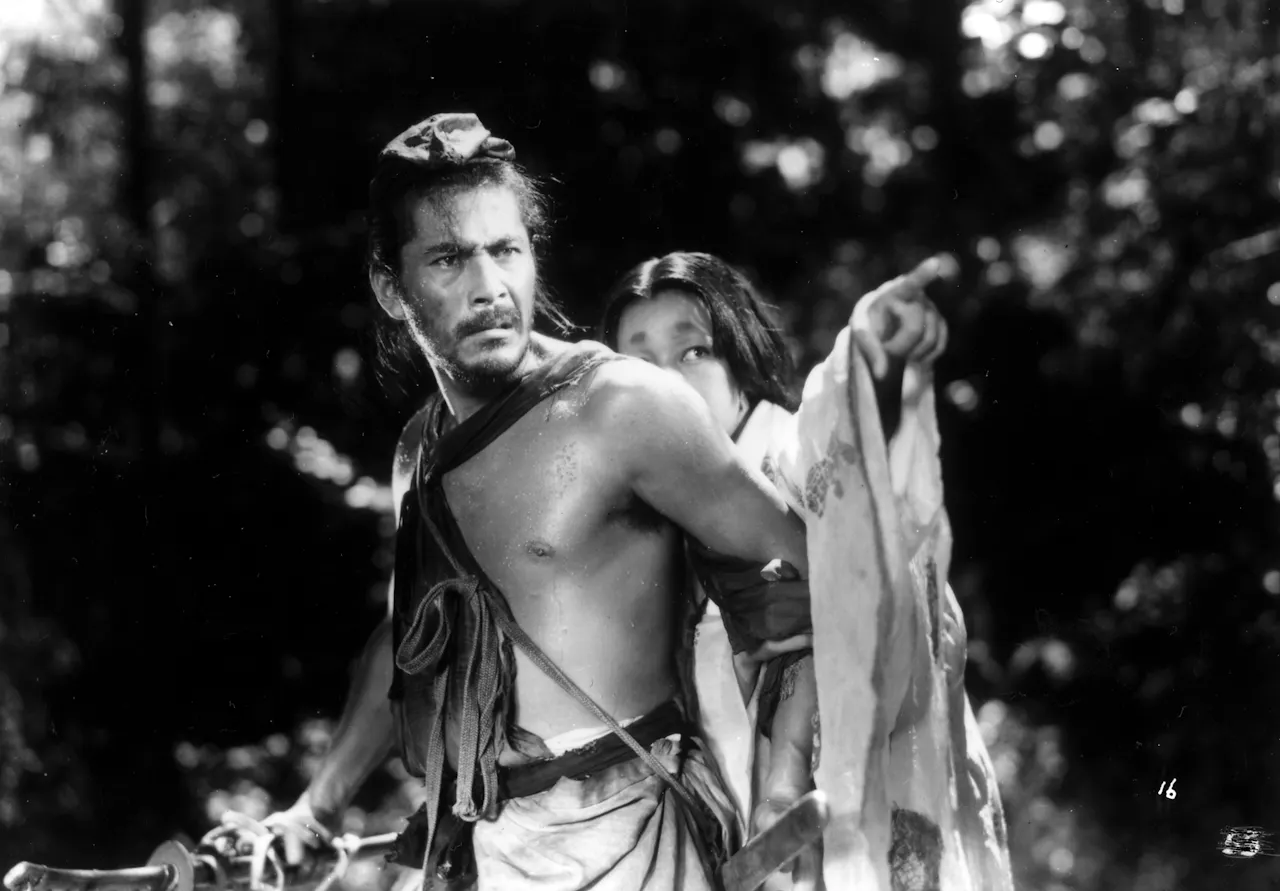
When Rashomon won the Golden Lion at Venice in 1951, most of the Western audience had never seen a Japanese film. What they took away was the structure: a bandit, a samurai's wife, the dead samurai speaking through a medium, and a woodcutter each describe the same encounter in a grove, and the accounts cannot be reconciled. The phrase "Rashomon effect" has since escaped into law, psychology and journalism to describe exactly that.
The structure came from two short stories by Ryūnosuke Akutagawa, "In a Grove" and "Rashōmon." What Akira Kurosawa and his cinematographer Kazuo Miyagawa added was a way of photographing uncertainty. This is a look at that: the light, the rain, the movement, and why the film would not work as a radio play.
Two locations, two climates
The film has exactly two worlds. At the ruined Rashōmon gate, in a downpour, a woodcutter (Takashi Shimura) and a priest (Minoru Chiaki) tell a cynical commoner (Kichijirō Ueda) what they heard at the magistrate's court. In the forest, in blazing sunlight, we see the versions of what happened. The gate is a built set; the forest scenes were shot in real woodland near Nara and at a temple outside Kyoto.
The contrast is the first and simplest piece of design. The frame story is dark, wet, static and vertical: heavy beams, falling water, three men who barely move. The stories inside it are bright, dry, restless and horizontal: figures running through undergrowth, the camera tracking beside them. We are told the truth is unknowable in the rain; we are shown four confident, sunlit versions of it. The film's argument is in the cut between the two climates.
Pointing the camera at the sun
Miyagawa is usually credited with being among the first cinematographers to point the lens directly at the sun, shooting up through the forest canopy so that the light flares and breaks into fragments between the leaves. Conventional wisdom said it would damage the film or the camera, or simply produce a white blob. What it produced instead is the film's most quoted image: dappled, shifting light that never lets a face stay fully lit for more than a second.
Watch how that light is used on the characters. When the bandit Tajōmaru (Toshiro Mifune) first sees the wife (Machiko Kyō), it is because a breeze lifts her veil and a shaft of sun hits her face: a moment of desire staged as a lighting cue. Throughout the forest, faces move in and out of leaf shadow as they talk, so that an expression is half hidden exactly when we most want to read it. The forest is doing the work an unreliable narrator does in a novel.
The crew also used mirrors to bounce direct sunlight into the actors' faces, a practical solution to the darkness under the trees that reads on screen as a kind of interrogation light. Nobody in this forest gets to stay in comfortable shade.
Rain you can see
Rain is notoriously hard to photograph; on black-and-white stock it tends to disappear against a grey sky. For the gate scenes the production is said to have tinted the water with black calligraphy ink so it would register. The result is a downpour that looks almost solid, a curtain the three men sit behind. The visual rhyme is clear enough: the frame story is literally veiled, and the men who claim to be sorting truth from lies are sitting in the dark behind a wall of water.
The rain also gives the frame story its sound. There is little music at the gate; there is the roar of water on tile, and voices raised over it. When the film moves into the forest, that roar cuts out and Fumio Hayasaka's score takes over, an insistent, repetitive piece whose resemblance to Ravel's Boléro was noticed at the time and has been argued about since. Sound tells you which world you are in before the image does.
A camera that moves like a witness
The most radical thing in Rashomon is the least remarked on: the camera almost never rests in the forest. The woodcutter's walk into the grove near the beginning is a sequence of long tracking shots with no dialogue, the camera gliding beside and ahead of him through the trees while the light flickers over his face. Nothing happens for several minutes except walking. What the sequence establishes is that this camera is a participant. It has a body; it moves through the same undergrowth as the characters; it can be blocked by a tree.
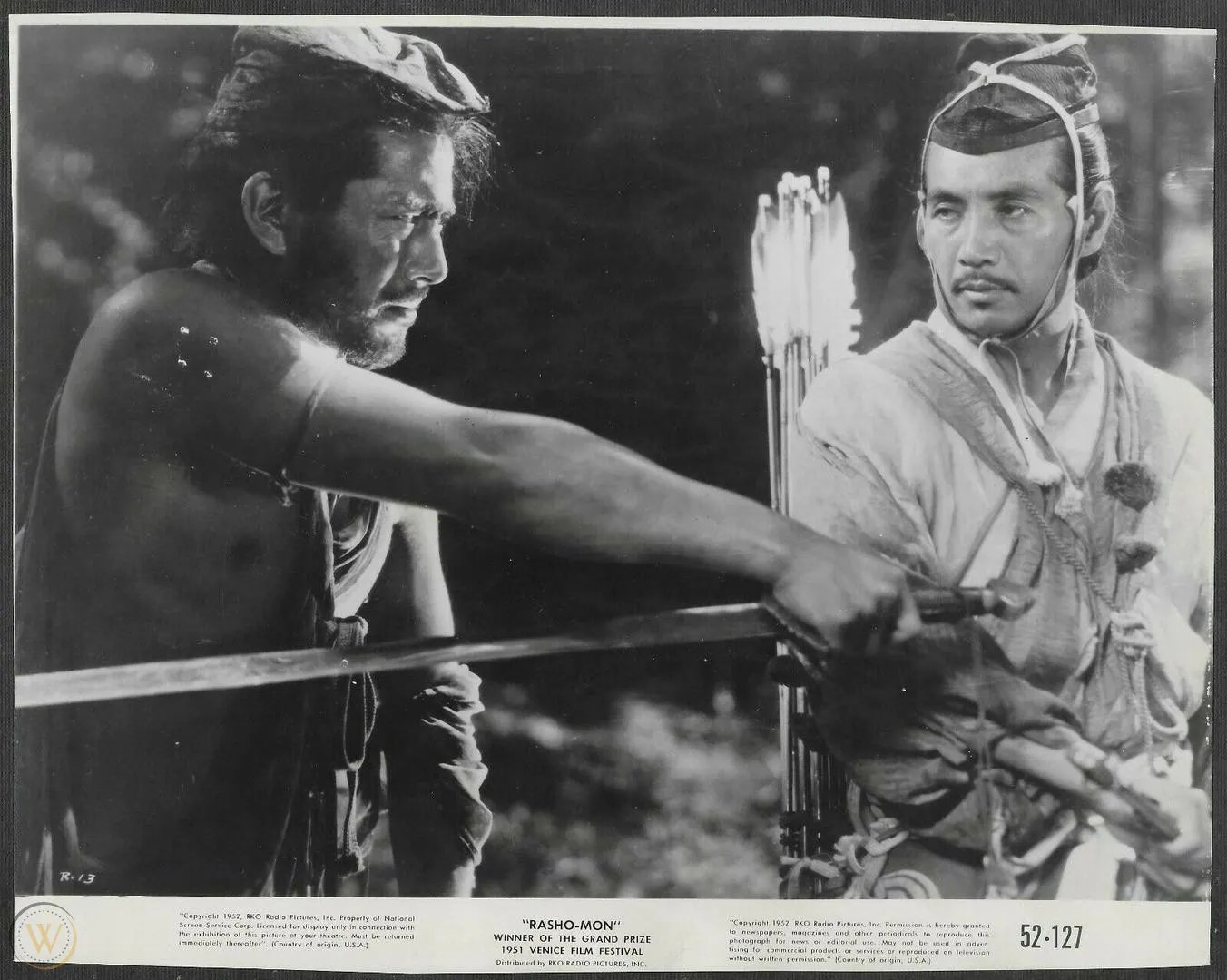
Once that is established, each version of the story is shot with its own physical attitude. The bandit's account is the most kinetic: long takes, sweeping movement, a duel that plays as a boastful dance. The wife's is closer and more claustrophobic, built around her face and the two men's stares. The samurai's, spoken through the medium, is the stillest and most formal. And the woodcutter's, the one we are invited to take as closest to the truth, is the least flattering to everyone, shot with an almost documentary plainness: a duel of frightened men stumbling and dropping their swords.
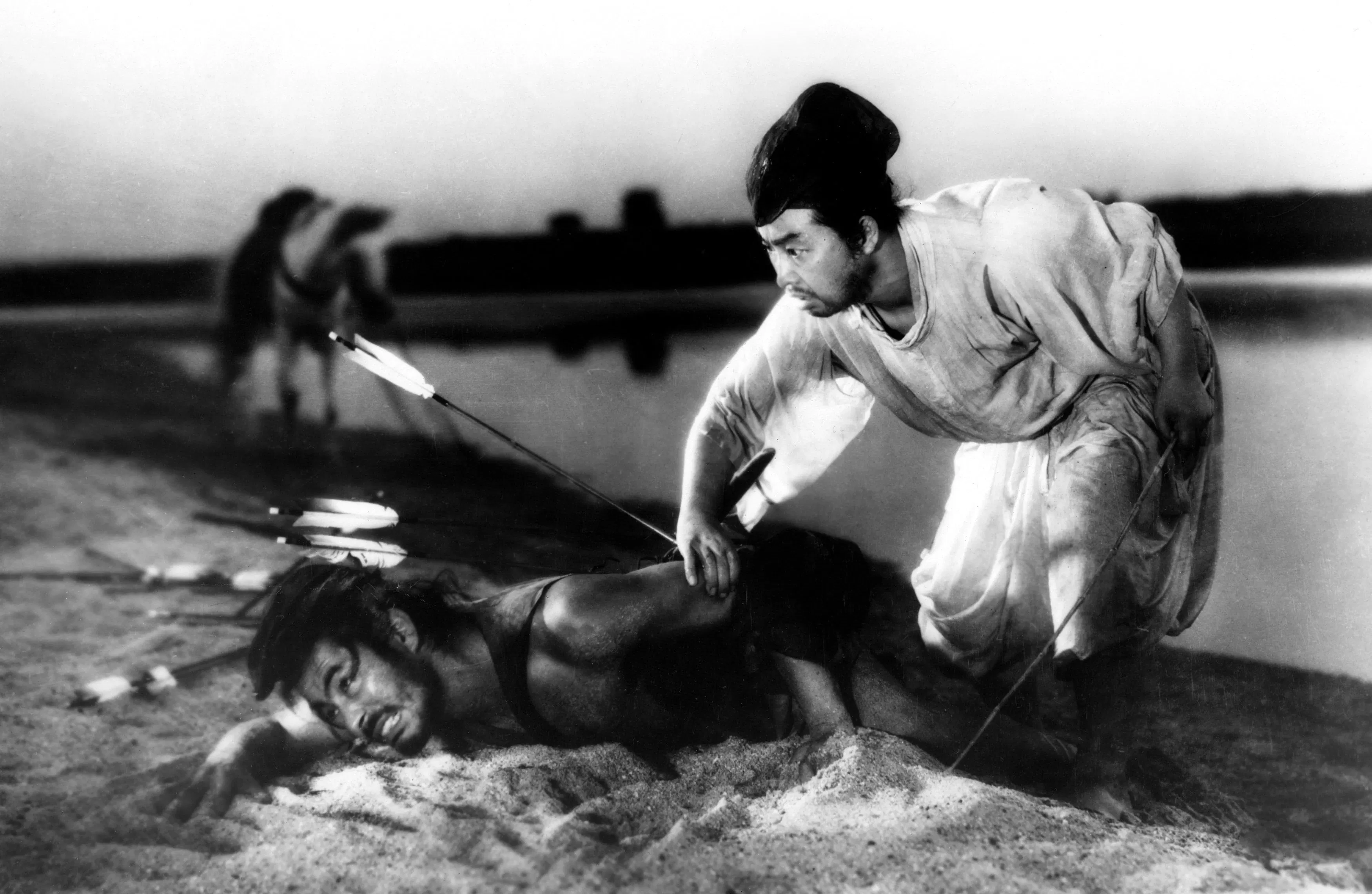
This is the analytical key to the film. Kurosawa does not signal "this narrator is lying" with a title card or a distorted lens. He gives each narrator a camera style that matches their self-image, and lets us notice that the same event photographed four ways is four different events. The style is the unreliability.
Looking at the audience
A related device: at the magistrate's court, the witnesses speak directly to the camera. The magistrate is never shown; the questions are never heard. We occupy the seat of judgment, and the film declines to fill it with anyone else. Kurosawa is not being coy. He is making the structure of the film into a moral position: you have heard four stories, you have been addressed as the judge, and you will not be given a verdict.
The triangle
Within the forest, Kurosawa's blocking returns again and again to triangles: bandit, wife and bound samurai arranged so that each is watching the other two. The staging makes the shifting alliances visible. In one version the wife is the apex, both men turned toward her; in another she is pushed to a corner while the men face each other. If you sketch the positions at the start and end of each account, you get a map of who each narrator wants you to believe held the power.
Why it is still taught
- Structure needs a visual equivalent. A story about unreliable accounts is photographed unreliably: broken light, veils of rain, a camera that takes sides.
- Practical solutions become style. Mirrors for fill light and ink in the rain were problems solved on set. They are now the images the film is remembered for.
- The camera can have a point of view without a POV shot. The woodcutter's walk teaches an audience that this camera is a body in the world; everything after that inherits its subjectivity.
- Blocking is argument. Triangles that shift between versions tell you who each narrator thinks was in charge.
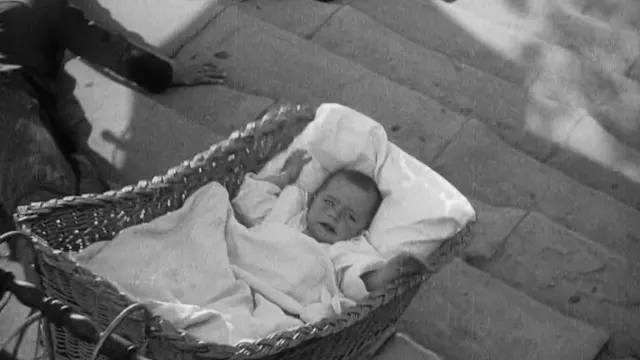
The film ends with the woodcutter carrying an abandoned baby out of the gate as the rain stops and the sun comes out. Critics have called the ending sentimental, and Kurosawa's own account of the shoot suggests he did not think of it that way. Formally it is exact: for the first time the gate is lit by the light of the forest. The two climates have met. Whether that means anything about truth is, as with everything else in the film, left to the judge's seat.