The Long Take: From Touch of Evil to Children of Men, Twenty Years On
Children of Men premiered at Venice in September 2006 and its unbroken sequences are still the benchmark. What a long take actually does to an audience, how the great ones were made, and why the most convincing of them are not really one shot at all.
On 3 September 2006, Alfonso Cuarón's Children of Men premiered at the Venice Film Festival. It underperformed at the box office, picked up three Oscar nominations (cinematography, editing, adapted screenplay) and none of the awards, and then spent the next twenty years climbing every list of the century's best films. Most of the praise fastens on two sequences: an ambush on a country road, shot from inside a moving car, and a six-minute run through a besieged refugee camp during a battle, both apparently without a cut.
The long take is the most visible technique in cinema, the one even casual viewers notice and name. It is also the most misunderstood. This is a look at what it does, how the landmark examples were achieved, and why the ones that impress us most are usually hiding their seams.
What a cut gives you, and what it costs
Editing is compression. A cut can skip an hour, cross a city, or turn a face toward whatever the director wants you to feel. It also gives the audience a small exit every few seconds: the moment of the cut is a moment of reorientation, and reorientation is relief.
A long take withholds that relief. Time on screen equals time in the seat. If a character walks down a corridor for forty seconds, you wait forty seconds. This is why the technique is so often used for suspense (the hallway before the door) and for immersion (the walk into a party). It is also why it fails when nothing in the frame is changing: without cuts, the composition has to do the editing, moving the eye from one part of the frame to another through blocking, light and camera movement.
The good long take, in other words, is not the absence of editing. It is editing performed inside the shot.
Welles: the crane and the bomb
The opening of Orson Welles's Touch of Evil (1958) is the classic training example. A bomb is placed in the trunk of a car; the camera rises on a crane and follows the car through a border town for over three minutes while a couple walks alongside, crosses paths with it, stops at a checkpoint, and kisses, at which moment the car explodes off screen and the shot ends. Every element of a thriller sequence is present (the ticking device, the innocent bystanders, the false calm) and none of it is cut. The audience knows what is in the trunk and cannot look away, because the shot will not let them.
Note how much "editing" is happening inside the frame: the camera rises and falls to shift from the car to the couple and back; extras cross to hide and reveal; the pace of the walk sets the pace of the shot. This is the template. Almost every long take since is a variation on it.
Hitchcock: the experiment that proved the rule
Rope (1948) tried to make an entire feature look like one continuous shot, with takes running up to the ten minutes a film magazine allowed and cuts hidden behind an actor's back or a piece of furniture. Alfred Hitchcock later called it a stunt, and it is instructive precisely because it does not fully work: the camera has to keep manoeuvring around a studio apartment, the actors have to hit marks with a precision that sometimes shows, and the lack of cuts drains tension rather than building it, because a thriller needs the ability to withhold information and the unbroken shot keeps showing everything. The lesson stuck. Long takes work as sequences inside a film, not as a substitute for a film.
Brown's invention: the camera learns to walk
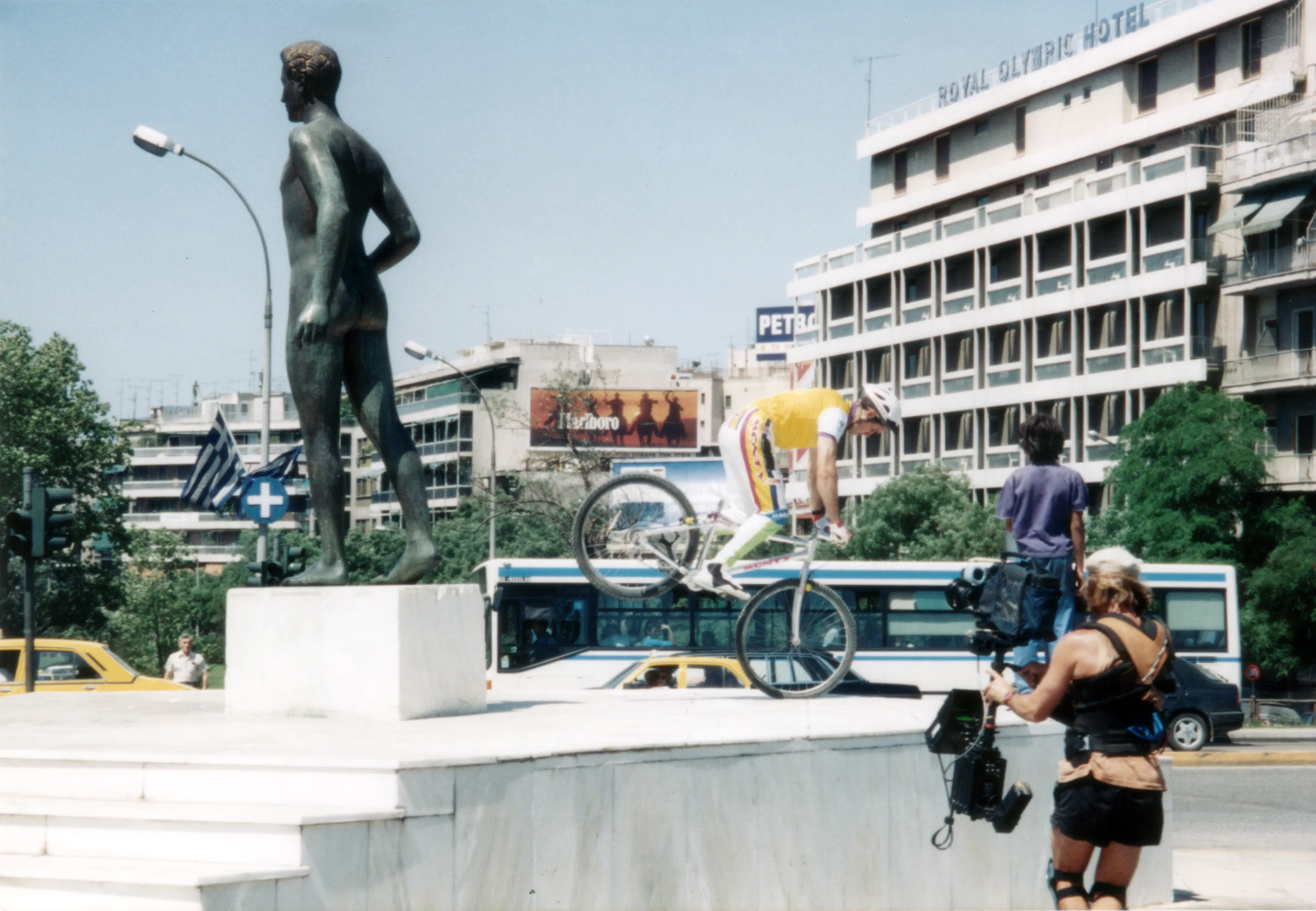
Until the mid-1970s a moving camera meant a dolly on track, a crane, or a hand-held shot that shook. Garrett Brown's Steadicam, a sprung arm and gimbal worn on a vest, isolated the camera from the operator's steps and made it possible to walk, climb stairs and pass through doorways with a floating, smooth image. It first appeared in features in 1976, and within a few years the walking long take had become a genre of its own.
The peak of that genre is probably the Copacabana shot in Martin Scorsese's Goodfellas (1990): Henry leads Karen from the street, through a back door, down a corridor, through the kitchen and into the nightclub, where a table is carried out and set for them, all in one continuous Steadicam move of about three minutes. The shot is not showing off for its own sake. It is showing Karen, and us, what Henry's life feels like from inside: every door opens, everyone knows him, the world rearranges itself as he walks. A cut would have broken the spell, because a cut would have let us step outside it.
The digital era: one take, or the appearance of one
Digital capture removed the ten-minute magazine limit and made genuinely single-shot features possible. Aleksandr Sokurov's Russian Ark (2002) is the purest case: a ninety-six-minute Steadicam walk through the Hermitage with hundreds of costumed extras, shot in one take, on the third attempt, on a single afternoon. It is astonishing as an event and, tellingly, is usually described as an event rather than as a film.
Most filmmakers took the other path. Birdman (2014), also photographed by Emmanuel Lubezki, appears to be a single shot and is in fact many, joined by digital transitions hidden in whip pans, dark doorways and passing bodies. Sam Mendes's 1917 (2019) does the same across a whole war film. The "one-shot" movie became a genre in which the cuts are a game of hide and seek.
Children of Men: the honest fake
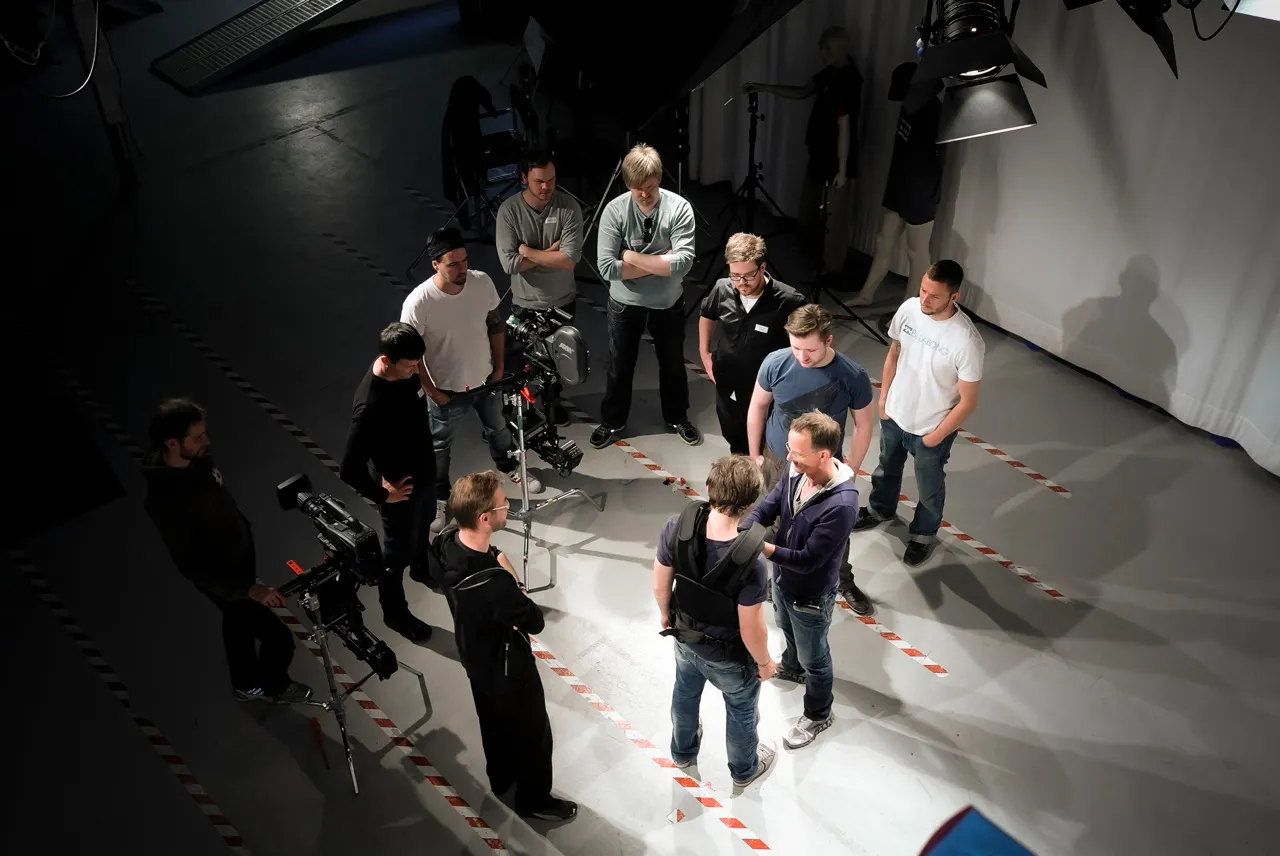
Which brings us back to Cuarón. When he described the car-ambush sequence he wanted, experts told him it was an impossible shot, and he proposed doing it with computer graphics. Lubezki refused; he wanted the feel of a raw documentary, not a synthetic camera. The solution was a rig from Gary Thieltges of Doggicam Systems: the car was rebuilt so the seats could tilt and lower actors out of the camera's path, the windshield could swing aside, and a crew of four rode on the roof operating a camera that could travel through the interior and out of the windows.
The battle sequence in the Bexhill camp, in which Theo runs through a building under fire, ran six minutes and eighteen seconds on screen. It took fourteen days to prepare and five hours to reset every time they wanted another attempt. Partway through the take that was used, blood spattered the lens; Lubezki persuaded Cuarón to keep it, and the smear has become one of the most imitated accidents in modern cinema.
Here is the part the legend usually leaves out. The visual effects supervisor Frazer Churchill has said plainly that the team had to combine several takes to create impossibly long shots. The opening coffee-shop sequence is two takes shot on consecutive days. The car ambush was shot in six sections across four locations over a week and joined with five digital transitions. The battle was captured in five takes across two locations. Cuarón himself has admitted, with a shrug, that sometimes it is more than what it looks like.
None of this diminishes the sequences. It clarifies them. The effect on an audience does not come from the literal absence of cuts; it comes from the absence of perceived cuts, from real time that is never interrupted, from a camera that behaves like a frightened person who cannot look away. Whether that camera was one machine or five, and whether the seam is a whip pan or a rendered frame, is a production question. The experience is the design.
How to think about your own long take
- Ask what the cut would have given you, and refuse it on purpose. If the answer is "nothing," you do not need a long take; you need a shorter scene.
- Edit inside the frame. Plan where the eye goes second by second: blocking, light changes, camera height, entrances and exits. Welles's crane is a lesson in this.
- Attach the camera to a consciousness. The Copacabana shot is Karen's. The Bexhill run is Theo's. A long take with no one to belong to is a tour.
- Hide the joins if you need them. A door, a dark wall, a pan across a body. The audience's experience of continuity is what you are protecting, not a technical record.
- Keep the accident. Blood on the lens, a stumble, a bird crossing the frame. The reason to shoot long is that real time produces things a cut would have removed.
Twenty years on, Children of Men still sets the standard because it understood the last point better than anyone. Its long takes are not about the absence of editing. They are about the presence of a world that will not stop for you to catch your breath.